
Property Investing Made Easy
How to Build a Property Investment Strategy in Australia
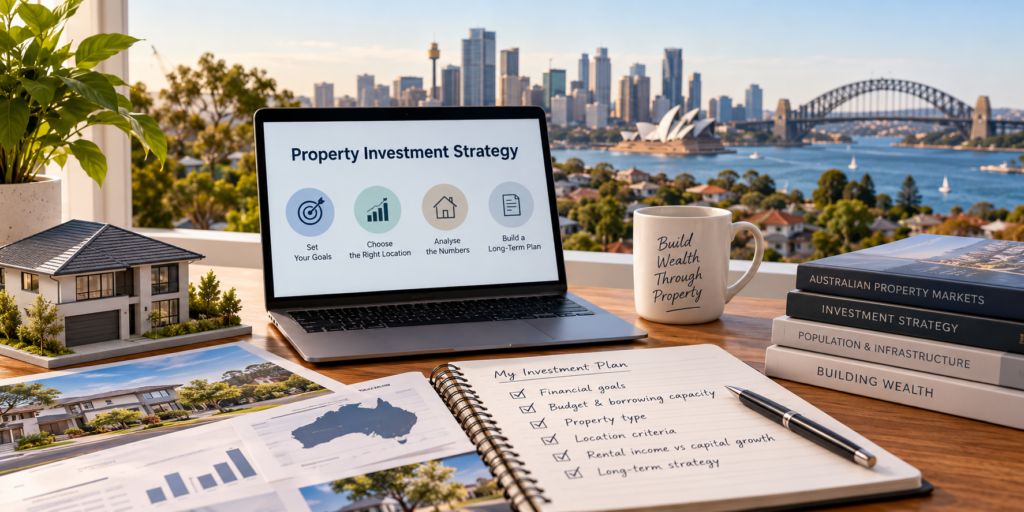
Successful property investing doesn’t start with browsing property listings or choosing a suburb. It starts with having a clear property investment strategy.
Without a strategy, it’s easy to become distracted by high rental yields, property hotspots, market headlines or properties that simply look appealing.
A well-defined strategy gives you a framework for deciding what to buy, where to buy it, how much you can comfortably invest and how the property fits into your long-term financial goals.
If you’re new to property investing, start with our Property Investing for Beginners in Australia guide before developing your own investment plan.
In this guide, we’ll explain how to build a property investment strategy in Australia and the key factors you should consider before purchasing an investment property.
What Is a Property Investment Strategy?
A property investment strategy is a structured plan that explains how you intend to use property to achieve your financial goals.
Your strategy should consider factors such as:
- Your financial goals
- Your investment timeframe
- Your available capital
- Your borrowing capacity
- Your preferred balance between capital growth and rental income
- The type of property you want to purchase
- The locations you want to target
- Your ability to manage risk and ongoing costs
Rather than asking, “What property should I buy?”, a better question is:
“What property strategy will best help me achieve my long-term financial goals?”
Why You Need a Property Investment Strategy Before Buying
One of the biggest mistakes first-time investors make is choosing a property before deciding what they actually want the investment to achieve.
A property can have a high rental yield but limited growth potential. Another property might have stronger long-term growth prospects but require greater cash-flow support.
Your strategy helps you understand these trade-offs before committing to a purchase.
It can also prevent emotional decisions. Instead of buying because you like the kitchen, the suburb or the appearance of the property, you can assess whether the investment actually supports your objectives.
Step 1: Define Your Property Investment Goals
Before researching suburbs or speaking with selling agents, determine what you want your investment portfolio to achieve.
Ask yourself:
- Are you focused on long-term wealth creation?
- Do you want stronger rental income?
- Are you building a property portfolio?
- Do you want to generate passive income in the future?
- Are you investing for retirement?
- Do you want to reduce your home mortgage over time?
- What is your investment timeframe?
There isn’t one correct answer. Your strategy needs to reflect your personal financial circumstances and objectives.
Step 2: Decide Between Capital Growth and Rental Income
Two of the most important concepts in property investing are capital growth and rental yield.
Capital growth is the increase in a property’s value over time, while rental yield measures the rental income generated by the property relative to its value.
Investors focused on long-term wealth creation may place greater emphasis on capital growth, while investors seeking stronger short-term cash flow may prioritise rental yield.
However, these aren’t necessarily competing strategies. A well-selected property can potentially provide both long-term growth and sustainable rental income.
Read our guide to Capital Growth vs Rental Yield to understand how the two work together.
Step 3: Understand Your Financial Position
Your property investment strategy needs to be realistic about what you can afford.
Before looking at properties, consider:
- Your available savings
- Your borrowing capacity
- Existing mortgages and debts
- Your household income
- Your monthly cash flow
- Your expected investment property expenses
- Your emergency financial buffer
It’s important to distinguish between your maximum borrowing capacity and your comfortable investment budget.
A lender may be willing to lend you a certain amount, but that doesn’t necessarily mean borrowing the maximum is the right strategy for you.
Your goal should be to build a portfolio that you can comfortably hold through changing interest rates, vacancies and unexpected expenses.
Step 4: Choose the Right Property Type
Your investment strategy should influence the type of property you consider.
| Property Type | Potential Advantages | Potential Considerations |
|---|---|---|
| House | Land component, family appeal and potential for long-term growth | Higher purchase price and maintenance costs |
| Apartment | Lower entry price and potential rental demand | Body corporate fees and potential oversupply |
| Townhouse | Balance between affordability, land and tenant appeal | Body corporate or shared-property considerations |
| Duplex | Potential for multiple rental income streams | Higher purchase price and more complex management |
There is no universally “best” investment property. The right choice depends on your budget, location, investment objectives and overall strategy.
Step 5: Develop a Location Strategy
Location should be a major component of your property investment strategy.
Australian property markets don’t all perform in the same way. Some locations experience strong population growth and increasing demand, while others may remain relatively flat.
When researching a location, consider:
- Population growth
- Employment opportunities
- Infrastructure investment
- Transport connections
- Rental demand
- Vacancy rates
- Housing supply
- Land availability
- Local economic drivers
- Future development
The Australian Bureau of Statistics provides population and demographic data that can help investors understand how Australia’s population is changing.
Rather than simply asking which suburb is popular today, consider:
“Why will people want to live here in 10 years?”
Step 6: Assess the Numbers
A strong property investment strategy needs to account for the financial performance of each potential investment.
Before purchasing, estimate:
| Financial Factor | What to Consider |
|---|---|
| Purchase Price | Does the property fit within your investment budget? |
| Rental Income | What rent is realistically achievable? |
| Rental Yield | How does the rental return compare with the property’s value? |
| Loan Costs | Can you comfortably manage repayments? |
| Property Management | What will professional management cost? |
| Maintenance | What ongoing repairs and maintenance should you expect? |
| Vacancy | What happens financially if the property is temporarily vacant? |
Don’t focus on rental yield alone. A high-yield property isn’t automatically a better investment if the location has weak demand or limited long-term growth potential.
Step 7: Stress-Test Your Strategy
Property investing is a long-term commitment, so your strategy should work under different market conditions.
Consider what would happen if:
- Interest rates increased
- Your property remained vacant for several weeks
- Unexpected repairs were required
- Your rental income was lower than expected
- Your personal income temporarily decreased
- Property values fell in the short term
A strategy that only works when everything goes perfectly isn’t a particularly resilient strategy.
Building an adequate financial buffer can help you manage unexpected changes without being forced to sell an investment at the wrong time.
Common Property Investment Strategy Mistakes
1. Chasing the Highest Rental Yield
High rental yield can look attractive, but yield is only one part of the investment equation.
Consider rental demand, location fundamentals, vacancy rates and long-term growth potential as well.
2. Buying Based on Emotion
An investment property shouldn’t be selected simply because you love the kitchen, backyard or suburb.
Focus on what future tenants and buyers are likely to value.
3. Trying to Time the Market
Waiting for the “perfect” market conditions can result in endless delays.
Instead of trying to predict every market movement, focus on purchasing quality property that aligns with your strategy and financial position.
4. Borrowing the Maximum Amount Available
Maximum borrowing capacity doesn’t necessarily equal a sensible investment budget.
Leave room for interest rate changes, vacancies and unexpected expenses.
5. Ignoring Cash Flow
Even a property with strong long-term growth potential needs to be financially sustainable.
Understand your expected rental income and all ongoing ownership costs before purchasing.
6. Following Property Hotspots Without Research
By the time a suburb becomes a major media headline, investors may already be competing heavily for properties.
Look beyond headlines and investigate the underlying fundamentals yourself.
Property Investment Strategy Checklist
Before purchasing an investment property, work through this checklist:
| Question | Yes / No |
|---|---|
| Do I have a clear investment goal? | ☐ |
| Does the property support my overall strategy? | ☐ |
| Do I understand my borrowing capacity? | ☐ |
| Can I comfortably afford the property? | ☐ |
| Is rental demand strong? | ☐ |
| Does the location have strong long-term fundamentals? | ☐ |
| Have I researched population and employment trends? | ☐ |
| Have I considered future housing supply? | ☐ |
| Have I stress-tested my cash flow? | ☐ |
| Am I making the decision based on research rather than emotion? | ☐ |
Frequently Asked Questions
What is a property investment strategy?
A property investment strategy is a plan that outlines how you intend to use property to achieve your financial goals. It considers factors such as your budget, borrowing capacity, investment timeframe, location, property type, rental income and growth objectives.
What is the best property investment strategy in Australia?
There isn’t one strategy that works for every investor. The right approach depends on your financial position, goals, risk tolerance and investment timeframe. Some investors prioritise capital growth, while others place greater emphasis on cash flow.
Should I focus on capital growth or rental yield?
It depends on your objectives. Many long-term investors aim to balance capital growth with sustainable rental income rather than focusing exclusively on one measure.
How much money do I need to start property investing?
The amount required depends on the property price, deposit, lending structure and your individual financial circumstances. You also need to consider purchasing costs and an ongoing financial buffer.
Should I buy a house, apartment or townhouse?
There is no universally best property type. The right choice depends on your investment strategy, budget, location and local market conditions.
How important is location when investing in property?
Location is one of the most important factors to consider because population growth, employment, infrastructure, rental demand and housing supply can all influence long-term property performance.
Build Your Strategy Before You Buy
A successful property investment strategy isn’t about finding the perfect property.
It’s about understanding what you’re trying to achieve, knowing what you can comfortably afford and selecting investments that support your long-term objectives.
The strongest strategies are built around research rather than emotion. They consider capital growth, rental income, cash flow, location fundamentals, borrowing capacity and risk before a purchase is made.
If you’re still developing your investment approach, the best place to start is with education and a clear understanding of your financial goals.
Ready to Build Your Property Investment Strategy?
Property investing doesn’t have to feel overwhelming.
At Compass Property Investing, we help investors understand their options, develop a strategy aligned with their goals and identify property opportunities based on long-term fundamentals.
Book a free property investment consultation with Compass to discuss your goals and understand what your next step could look like.
Disclaimer: This article is provided for general educational purposes only and does not constitute financial, legal or tax advice. Property investment involves risks, and you should consider obtaining advice from appropriately qualified professionals before making investment decisions based on your individual circumstances.