
Property Investing Made Easy
Property Investing for Beginners in Australia:
The Complete Guide (2026)
Buying your first investment property is one of the biggest financial decisions you’ll ever make. Yet for many Australians, knowing where to begin can feel overwhelming.
Should you buy a house or an apartment? How much deposit do you actually need? Is now the right time to invest? And with so much conflicting advice online, it can be difficult to separate proven investment principles from marketing hype.
The good news is that successful property investing doesn’t require perfect timing or expert market predictions. It starts with understanding the fundamentals, setting clear financial goals and making decisions based on research rather than emotion.
Australian property has long been one of the country’s preferred wealth-building assets. While every investment carries risk, well-selected residential property has helped many Australians build equity, generate rental income and create long-term financial security through disciplined investing and time.
Whether your goal is to build passive income, reduce your mortgage sooner, create wealth for your family or prepare for retirement, learning the basics of property investing is the first step.
This guide has been created specifically for Australians who are considering their first investment property. We’ll walk you through the fundamentals of property investing, explain how investors build wealth, explore the different types of investment properties, outline the costs involved and share practical strategies that can help you make informed decisions with confidence.
By the end of this guide, you’ll understand not only how property investing works in Australia but also the mindset and framework used by experienced investors to build wealth over the long term.
Table of Contents
What Is Property Investing?
For many Australians, buying a home is a milestone. Buying an investment property, however, is a financial strategy.
Instead of purchasing a property to live in, you’re buying it with the goal of growing your wealth over time. That growth can come from two main sources: the rental income you receive from tenants and the increase in the property’s value over the years, known as capital growth.
Unlike other investments that can fluctuate significantly from day to day, property is generally considered a long-term asset. Successful investors don’t focus on what their property is worth next month—they focus on where it could be in 10, 20 or even 30 years.
Of course, property investing isn’t about buying any house and hoping for the best. The most successful investors follow a strategy. They look for properties in locations with strong long-term fundamentals, understand the costs involved, manage risk and make decisions based on data rather than emotion.
How Do Property Investors Make Money?
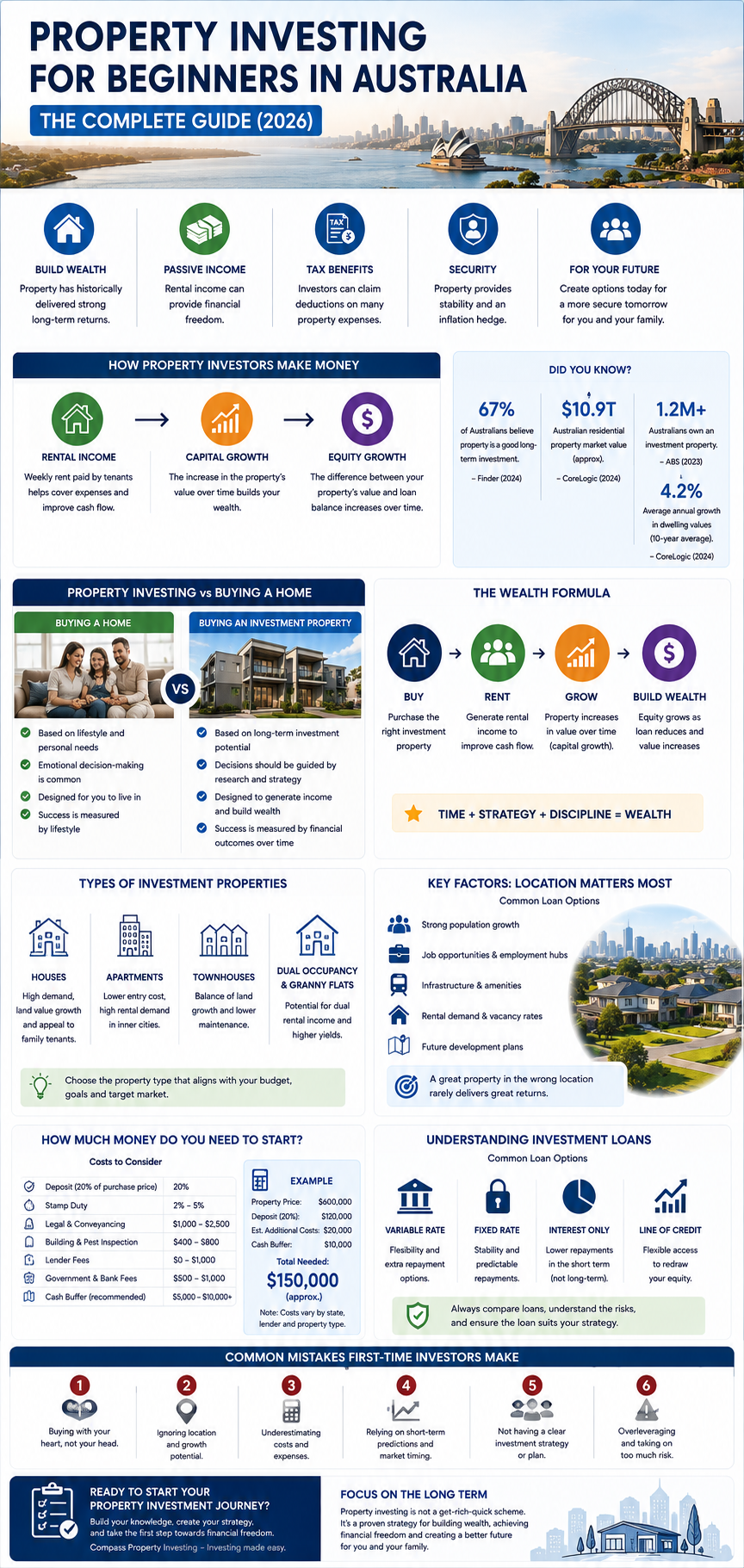
Most investment properties generate returns in three ways:
Source of Return | What It Means | Why It Matters |
Rental Income | Weekly rent paid by tenants. | Helps cover mortgage repayments and ongoing property expenses. |
Capital Growth | The increase in the property’s value over time. | Builds wealth and increases your net worth. |
Equity Growth | The difference between your property’s market value and the amount you still owe on your loan. | Can provide opportunities to finance future investments. |
These three components often work together. As your property grows in value and your loan balance decreases, your equity increases. At the same time, rental income can help offset ownership costs and improve your cash flow.
Property Investing vs Buying a Home
One of the biggest mindset shifts for first-time investors is understanding that an investment property should be chosen differently from a family home.
When buying a home, personal preferences usually take priority. You might choose a property because it’s close to work, near good schools or has a kitchen you love.
An investment property, however, should be assessed through the lens of financial performance.
Buying a Home | Buying an Investment Property |
Based on lifestyle and personal needs | Based on long-term investment potential |
Emotional decision-making is common | Decisions should be guided by research and strategy |
Designed for you to live in | Designed to generate income and build wealth |
Success is measured by lifestyle | Success is measured by financial outcomes over time |
That doesn’t mean an investment property has to be unattractive. It simply means that factors such as location, rental demand, population growth, infrastructure investment and future development potential generally carry more weight than personal taste.
Property Investing Is a Long-Term Journey
One of the most common misconceptions is that property investing delivers quick profits.
While some markets experience rapid growth, property has historically rewarded investors who take a long-term approach. Market conditions will change, interest rates will rise and fall, and economic cycles will continue—but investors who remain focused on their strategy are often better positioned to benefit from long-term trends rather than short-term fluctuations.
For beginners, this means thinking beyond the next 12 months and asking a more important question:
Will this property still be a strong investment in 10 or 20 years?
Keeping that long-term perspective can help you avoid emotional decisions and stay focused on building sustainable wealth.
Why Australians Invest in Property
Why Do So Many Australians Choose Property as an Investment?
If you’ve ever spoken to someone who’s built long-term wealth in Australia, there’s a good chance property has played a role in their journey.
While shares, managed funds and superannuation all have their place in a diversified portfolio, residential property continues to be one of Australia’s most popular investment choices. That’s because it offers something many investors value—a tangible asset with the potential to generate regular income while increasing in value over time.
Of course, no investment is guaranteed, and property markets move through cycles. However, many Australians are attracted to property because it can provide multiple ways to build wealth rather than relying on a single source of return.
The Benefits of Property Investing
Property offers several potential advantages that have made it a cornerstone of many long-term wealth strategies.
Benefit | Why It Matters |
Potential Capital Growth | Well-located properties may increase in value over the long term, helping grow your overall wealth. |
Rental Income | Weekly rental payments can contribute towards mortgage repayments and ongoing expenses. |
Leverage | Property allows investors to borrow money to purchase a higher-value asset, potentially magnifying returns as well as risks. |
Equity Growth | As your property’s value increases and your loan reduces, you may build equity that could support future investment opportunities. |
Tax Considerations | Depending on your circumstances, investment properties may offer tax benefits. Professional tax advice should always be sought before making investment decisions. |
Property vs Other Investment Options
Every investment has its own strengths, risks and role within a financial plan. Rather than asking which investment is “best”, it’s more useful to understand how property compares with other common asset classes.
Investment | Potential Income | Growth Potential | Volatility | Physical Asset |
Residential Property | Rental income | Long-term capital growth | Generally lower day-to-day price movements | ✅ Yes |
Shares | Dividends | Capital growth | Higher short-term market fluctuations | ❌ No |
Term Deposits | Interest | Limited | Very low | ❌ No |
Superannuation | Depends on investment mix | Long-term | Varies | ❌ No |
Many experienced investors choose to hold a mix of investments rather than relying on a single asset class. Property can form an important part of that broader strategy.
Why Location Matters More Than Timing
One of the most common questions first-time investors ask is:
“Is now the right time to invest?”
While market conditions are always worth considering, experienced investors often place greater emphasis on buying the right property in the right location than on trying to perfectly time the market.
Areas with strong population growth, employment opportunities, infrastructure investment, quality schools and consistent housing demand have historically shown stronger long-term performance than locations chosen purely because they’re affordable.
Rather than trying to predict short-term market movements, successful investors often focus on buying quality assets they can comfortably hold through different market cycles.
Property Investing Isn’t Risk-Free
Although property has helped many Australians build wealth, it’s important to recognise that every investment carries risk.
Some of the challenges investors may face include:
- Interest rate increases.
- Vacancies between tenants.
- Unexpected maintenance or repair costs.
- Changes in government policy or taxation.
- Market downturns in certain locations.
- Cash flow pressures if expenses exceed rental income.
Understanding these risks from the outset allows you to plan for them, rather than being surprised later.
Think Long Term, Not Short Term
One of the biggest differences between successful investors and those who struggle is their time horizon.
Property investing is rarely about making a quick profit. It’s about building wealth gradually through consistent decision-making, careful planning and patience.
Markets will rise and fall, headlines will change and interest rates will fluctuate. Investors who remain focused on their long-term strategy are generally better placed to navigate these cycles than those who react to every piece of market news.
Is Property Investing Right for You?
Property investing has helped many Australians build wealth over the long term, but that doesn’t automatically mean it’s the right choice for everyone.
Like any investment, buying property involves financial commitments, ongoing responsibilities and a willingness to think beyond short-term market movements. Before purchasing your first investment property, it’s worth taking a step back and asking whether you’re financially and personally ready for the journey.
The best investors don’t buy simply because everyone else is doing it—they invest because it aligns with their goals, financial position and long-term plans.
Start With Your Financial Goals
Before looking at suburbs, loan options or property prices, ask yourself a simple question:
“Why do I want to invest in property?”
Your answer will influence almost every decision you make.
For example, your goal might be to:
- Build long-term wealth for your family.
- Generate passive income over time.
- Create additional income for retirement.
- Diversify your investments beyond shares or superannuation.
- Purchase assets that have the potential to grow in value over the long term.
There isn’t a single “right” reason to invest, but having a clear objective makes it easier to develop a strategy that suits your circumstances.
Are You Financially Ready?
Buying an investment property involves more than saving a deposit.
You’ll also need to consider:
- Your current income and employment stability.
- Existing debts and financial commitments.
- Your borrowing capacity.
- Ongoing property expenses.
- Your ability to manage unexpected costs.
- Whether you have an emergency financial buffer.
A lender may approve your loan, but it’s equally important that you feel comfortable managing the repayments if circumstances change.
Being financially prepared can give you greater confidence when market conditions become less predictable.
Do You Have the Right Mindset?
Successful property investing is often less about finding the “perfect” property and more about maintaining the right mindset.
That usually means being prepared to:
- Think in decades rather than months.
- Stay calm during market fluctuations.
- Base decisions on research instead of emotions.
- Continue learning as markets evolve.
- Remain patient while your investment strategy unfolds.
Many first-time investors spend too much time worrying about buying at the absolute bottom of the market. In reality, building wealth is often more closely linked to holding quality assets over the long term than trying to perfectly time your purchase.
Property Investing Comes With Responsibilities
Owning an investment property isn’t a completely hands-off investment.
Depending on how your property is managed, you’ll need to consider responsibilities such as:
- Organising finance.
- Budgeting for maintenance and repairs.
- Managing vacancies between tenants.
- Understanding landlord obligations.
- Reviewing your investment regularly as your circumstances change.
Many investors choose to work with experienced professionals—including mortgage brokers, buyers’ agents, accountants and property managers—to help navigate these responsibilities.
A Simple Self-Assessment
Before moving forward, ask yourself the following questions:
Question | Why It Matters |
Do I have a clear investment goal? | Your strategy should reflect your financial objectives. |
Can I comfortably manage the costs of ownership? | Property ownership involves more than mortgage repayments. |
Am I prepared to invest for the long term? | Property generally performs best over longer investment horizons. |
Can I handle changes in interest rates or market conditions? | Flexibility helps reduce financial stress during market cycles. |
Am I willing to seek professional advice when needed? | Expert guidance can help you make more informed decisions. |
If you answered “yes” to most of these questions, you may be in a good position to start exploring property investment further.
If not, that’s perfectly okay.
Sometimes the best investment decision is taking more time to strengthen your financial position before purchasing your first property.
Investing Isn’t a Race
One of the biggest misconceptions in property investing is the fear of missing out.
Media headlines, social media and conversations with friends can make it feel like you need to buy immediately before prices rise again.
In reality, successful investors usually don’t rush into the market.
They take the time to understand their finances, research different locations, seek professional advice where appropriate and buy when they’re confident their decision aligns with their long-term goals.
Buying the right property at the right time for your personal circumstances is often more important than trying to buy before everyone else.
How Does Property Investing Build Wealth?
One of the biggest misconceptions about property investing is that wealth comes from simply owning a property.
In reality, successful investors build wealth by understanding how several financial principles work together over time. Rather than relying on a single source of income or hoping for a quick increase in property prices, they focus on creating long-term value through a combination of capital growth, rental income and equity.
Think of property investing as building a financial engine. Each component plays a different role, but together they can help strengthen your overall financial position.
1. Capital Growth
Capital growth refers to the increase in your property’s market value over time.
For example, imagine you purchase an investment property for $650,000.
If, over the next ten years, its market value increases to $900,000, your property has experienced $250,000 in capital growth.
Although you don’t receive this money immediately, it contributes to your overall wealth by increasing the value of the asset you own.
This is one of the main reasons experienced investors often focus on buying quality properties in locations with strong long-term growth fundamentals rather than simply chasing the cheapest property available.
Key Point: Capital growth is typically realised over the long term. Short-term price movements are less important than the property’s long-term performance.
2. Rental Income
While your property’s value may increase over time, it can also generate income through rent paid by tenants.
This rental income can help offset ongoing costs such as:
- Mortgage repayments
- Council rates
- Property management fees
- Insurance
- Maintenance expenses
Depending on the property’s income and expenses, it may produce:
- Positive cash flow, where rental income exceeds expenses.
- Neutral cash flow, where income and expenses are roughly equal.
- Negative cash flow, where expenses are higher than rental income.
None of these outcomes are automatically “good” or “bad”. They simply reflect different investment strategies and financial circumstances.
3. Equity
Equity is one of the most powerful concepts in property investing, yet it’s often misunderstood by beginners.
Put simply, equity is the difference between your property’s current value and the amount you still owe on your home loan.
For example:
| Property Value | Loan Balance | Equity |
|---|---|---|
| $800,000 | $500,000 | $300,000 |
As your property increases in value and you gradually repay your loan, your equity may grow over time.
Many experienced investors use available equity—subject to lender approval and their financial circumstances—to help fund future investment opportunities. However, borrowing against equity increases debt and should always be considered carefully with professional advice.
4. The Power of Leverage
One characteristic that makes property different from many other investments is the ability to borrow a significant portion of the purchase price.
This is known as leverage.
For example, if you purchase a $700,000 investment property with a 20% deposit, you’re controlling a $700,000 asset while contributing only part of the purchase price yourself.
If the property’s value increases, the growth is based on the full value of the asset—not just your initial deposit.
However, leverage works both ways.
Just as it can amplify gains, it can also magnify losses if property values decline or borrowing costs increase. That’s why having a sound financial strategy and borrowing within your means is so important.
How These Four Components Work Together
Rather than relying on a single source of return, property investing combines several wealth-building mechanisms.
| Wealth Builder | What It Does |
|---|---|
| Capital Growth | Increases the value of your property over time. |
| Rental Income | Provides ongoing income that can help cover ownership costs. |
| Equity | Represents the growing value you own in the property. |
| Leverage | Allows you to control a larger asset using borrowed funds, while increasing both potential returns and risks. |
When these elements work together over many years, they can create opportunities to build wealth gradually.
A Long-Term Example
Imagine Sarah purchases her first investment property for $650,000.
Over the next 12 years:
- The property’s value gradually increases.
- Her tenants contribute rental income that helps cover ownership costs.
- She continues reducing her loan balance.
- As a result, her equity grows.
Sarah hasn’t become wealthy overnight. Instead, she’s benefited from consistent, long-term growth and disciplined investing.
This example highlights an important principle:
Property investing is generally about time in the market, not trying to perfectly time the market.
Types of Investment Properties in Australia
One of the first decisions you’ll make as a property investor is what type of property to buy.
There isn’t a single “best” investment property. The right choice depends on your budget, investment goals, risk tolerance and the local market you’re buying into.
For example, an investor focused on long-term capital growth may prioritise a different property than someone looking for stronger rental income today.
Understanding the strengths and trade-offs of each property type will help you make a decision that aligns with your strategy rather than following market trends or popular opinion.
Houses
Detached houses are often considered the traditional investment property in Australia.
Because houses typically sit on their own parcel of land, they generally have greater potential for long-term capital growth. This is because land is a finite resource, particularly in established suburbs where demand remains strong.
Houses also tend to attract families and long-term tenants, which may result in lower tenant turnover in some locations.
However, houses usually require a larger upfront investment and ongoing maintenance costs can be higher than other property types.
Houses may suit investors who:
- Are focused on long-term capital growth.
- Have a larger investment budget.
- Plan to hold the property for many years.
- Want exposure to land value.
Apartments and Units
Apartments and units are often more affordable than detached houses, making them an attractive option for first-time investors.
In many metropolitan areas, apartments can also provide relatively strong rental demand due to their proximity to employment hubs, universities, public transport and lifestyle amenities.
However, buyers should also consider factors such as body corporate fees, the age of the building and the level of future apartment supply in the area.
Not all apartment markets perform equally, so researching the local market is particularly important.
Apartments may suit investors who:
- Have a smaller investment budget.
- Prioritise rental demand.
- Prefer lower maintenance responsibilities.
- Want to invest closer to city centres.
Townhouses
Townhouses often sit somewhere between houses and apartments.
They may offer more living space than an apartment while requiring less maintenance than a standalone home.
Many townhouses appeal to families, couples and downsizers, making them popular in established suburban areas.
Their investment performance will largely depend on the surrounding suburb, local demand and future supply.
Duplexes
A duplex is a property that contains two separate dwellings on a single title or adjoining titles, depending on the development.
Some investors are attracted to duplexes because they can provide multiple rental income streams while still benefiting from land ownership.
However, they may also involve higher purchase prices and additional management considerations.
New Builds vs Established Properties
Another important decision is whether to purchase a newly built property or an established home.
Neither option is automatically better.
Each offers different opportunities depending on your investment objectives.
| New Build | Established Property |
|---|---|
| Modern design and inclusions | Established neighbourhoods |
| Lower maintenance in early years | Larger land component in many cases |
| Builder warranties | Proven market history |
| May attract depreciation benefits | Potential renovation opportunities |
| Sometimes higher purchase price | Character and established appeal |
Rather than focusing solely on whether a property is new or old, experienced investors often evaluate its long-term growth prospects, rental appeal and location fundamentals.
Don’t Buy Based on Emotion
One of the biggest mistakes first-time investors make is choosing a property they personally like rather than one that suits the market.
It’s natural to imagine whether you would enjoy living there.
But investment properties should be chosen based on what future tenants and buyers are likely to value.
Ask questions such as:
- Is there strong rental demand?
- Are employment opportunities growing?
- Is new infrastructure planned?
- Are schools, transport and shopping nearby?
- Does the suburb have long-term population growth?
- Is there limited land supply?
These factors often have a greater influence on investment performance than cosmetic finishes or personal taste.
Focus on Strategy, Not Property Type
Many beginners spend months trying to answer questions like:
- “Should I buy a house?”
- “Are apartments better?”
- “Should I buy brand new?”
Experienced investors often ask a different question:
“Which property best supports my investment strategy?”
The answer will be different for every investor.
Someone seeking strong long-term capital growth may prioritise a detached home in a high-demand suburb, while another investor may choose a well-located apartment because it better suits their budget and cash flow objectives.
The property itself is only one part of the equation. The quality of the location, the strength of the local market and your long-term strategy are usually just as important.
Quick Comparison
| Property Type | Upfront Cost | Growth Potential | Rental Yield | Maintenance | Typical Investor |
|---|---|---|---|---|---|
| House | High | High | Moderate | High | Long-term wealth builder |
| Apartment / Unit | Low–Medium | Moderate | Moderate–High | Low | First-time investors, city-focused buyers |
| Townhouse | Medium | Moderate–High | Moderate | Medium | Balanced growth and lifestyle markets |
| Duplex | High | Moderate–High | High | Medium | Investors seeking multiple income streams |
Note: Investment performance depends on the specific property, location, market conditions and your individual strategy. These comparisons are general in nature.
How Much Money Do You Need to Start Property Investing?
One of the biggest myths about property investing is that you need hundreds of thousands of dollars saved before you can buy your first investment property.
While having a larger deposit can provide more borrowing options and reduce your loan costs, it isn’t the only factor lenders consider. Your income, existing debts, borrowing capacity and overall financial position all play an important role.
The amount you’ll need depends on the type of property you’re buying, where it’s located and how you choose to finance the purchase.
The key is understanding the costs involved before you begin your property search.
Your Deposit Is Only Part of the Picture
When people talk about buying an investment property, they usually focus on the deposit.
While the deposit is important, it’s only one of several upfront costs you’ll need to budget for.
Depending on your circumstances, you may also need to consider:
- Stamp duty (where applicable).
- Legal and conveyancing fees.
- Building and pest inspections.
- Loan establishment costs.
- Lenders Mortgage Insurance (LMI), if your deposit is below the lender’s threshold.
- Property settlement costs.
- A financial buffer for unexpected expenses after purchase.
Planning for these costs early can help you avoid unnecessary financial pressure during the buying process.
How Much Deposit Do Most Investors Need?
There isn’t a one-size-fits-all answer.
Many lenders allow eligible borrowers to purchase an investment property with less than a 20% deposit, although this may involve additional costs such as Lenders Mortgage Insurance (LMI).
Generally speaking:
| Deposit | What It May Mean |
|---|---|
| 5–10% | May be possible with some lenders, but often results in higher borrowing costs and LMI. |
| 10–19% | More borrowing options may become available, although LMI may still apply. |
| 20% or more | Often avoids LMI and may provide greater flexibility with lending options. |
The right deposit isn’t simply the biggest one you can save—it’s the amount that supports your overall financial strategy while keeping your repayments manageable.
It’s Not Just About Saving More
Many first-time investors spend years trying to save a larger deposit while property prices continue to change.
In some cases, waiting may strengthen your financial position.
In others, delaying could mean paying more for the same type of property in the future.
Rather than focusing solely on reaching an arbitrary savings target, it’s often worth understanding your borrowing capacity, investment goals and purchasing timeframe before deciding when to enter the market.
Can You Use Equity Instead of Cash?
Some investors purchase their next investment property without saving an entirely new cash deposit.
Instead, they may use equity built up in an existing property, subject to lender approval and their financial circumstances.
This approach can provide additional flexibility, but it also increases borrowing and should only be considered after seeking appropriate financial and lending advice.
If you don’t already own property, building a deposit through savings remains the most common pathway into property investing.
Don’t Forget Ongoing Costs
Buying an investment property is only the beginning.
You’ll also need to budget for ongoing ownership costs such as:
- Mortgage repayments.
- Council rates.
- Water charges (where applicable).
- Landlord insurance.
- Property management fees.
- Repairs and maintenance.
- Periods when the property may be vacant.
Having a financial buffer can make it easier to manage these expenses without placing unnecessary strain on your finances.
Focus on Affordability, Not Maximum Borrowing
Just because a lender is willing to lend you a certain amount doesn’t necessarily mean you should borrow the maximum available.
Experienced investors often focus on purchasing a property they can comfortably hold over the long term—even if interest rates rise or unexpected expenses occur.
A sustainable investment strategy is generally built around affordability, flexibility and financial resilience rather than borrowing to the limit.
Before You Start Looking at Properties
Before browsing listings or attending open homes, consider taking the following steps:
✔ Understand your borrowing capacity.
✔ Estimate your total purchase costs.
✔ Build an emergency financial buffer.
✔ Review your household budget.
✔ Speak with qualified lending and financial professionals if needed.
Being prepared before you begin your property search can help you make decisions with greater confidence and avoid costly surprises later.
Understanding Investment Property Finance
For many first-time investors, finance is the part of property investing that feels the most intimidating.
Terms like borrowing capacity, loan-to-value ratio (LVR), interest-only loans and serviceability can quickly become overwhelming. The good news is that you don’t need to become a finance expert before purchasing your first investment property—you simply need to understand the key concepts that influence your borrowing power and long-term investment strategy.
A well-structured loan can support your investment goals, but it’s important to remember that finance should always complement your strategy—not drive it.
How Investment Property Loans Work
An investment property loan is similar to a standard home loan, but it’s specifically designed for a property that you intend to rent out rather than live in.
When assessing your application, lenders typically consider a range of factors, including:
- Your income and employment.
- Existing debts and financial commitments.
- Living expenses.
- Savings and available assets.
- Your credit history.
- The property’s value and expected rental income.
Every lender has its own lending policies, so borrowing capacity can vary depending on your circumstances.
Borrowing Capacity vs Budget
One of the most common mistakes first-time investors make is assuming that their maximum borrowing capacity should determine their property budget.
These are two very different things.
- Borrowing Capacity is the maximum amount a lender may be willing to lend based on your financial situation.
- Investment Budget is the amount you’re comfortable borrowing while still maintaining financial flexibility and meeting your long-term goals.
For many investors, choosing a property below their maximum borrowing limit provides a greater financial buffer if interest rates rise or unexpected expenses occur.
Common Loan Types
There are several loan structures available to property investors, but the two most common are:
| Loan Type | How It Works | Things to Consider |
|---|---|---|
| Principal & Interest (P&I) | Each repayment reduces your loan balance while also covering interest. | Builds equity more quickly but usually results in higher regular repayments. |
| Interest-Only (IO) | Repayments cover interest only for an agreed period, after which principal repayments usually begin. | Can improve short-term cash flow but does not reduce the loan balance during the interest-only period. |
Neither option is inherently better than the other. The right loan structure depends on your financial objectives, cash flow and overall investment strategy.
Understanding Loan-to-Value Ratio (LVR)
One term you’ll often hear when discussing property finance is Loan-to-Value Ratio (LVR).
LVR compares the amount you’re borrowing with the value of the property you’re purchasing.
For example:
| Property Value | Loan Amount | LVR |
|---|---|---|
| $800,000 | $640,000 | 80% |
| $800,000 | $720,000 | 90% |
Generally speaking, a lower LVR may provide access to a wider range of lending options and can reduce additional costs such as Lenders Mortgage Insurance (LMI). However, the most suitable LVR depends on your individual circumstances and investment strategy.
Why Cash Flow Matters
Owning an investment property involves ongoing financial commitments, not just mortgage repayments.
Before purchasing, it’s important to understand how your expected rental income compares with your ongoing expenses, including:
- Loan repayments.
- Council rates.
- Water charges (where applicable).
- Insurance.
- Property management fees.
- Repairs and maintenance.
- Vacancy periods.
Having a clear picture of your cash flow can help you determine whether a property is likely to fit comfortably within your overall financial plan.
Work with the Right Professionals
You don’t need to navigate property finance alone.
Many first-time investors build a team of professionals to help them make informed decisions, including:
- Mortgage brokers, who can compare lending options from different lenders.
- Accountants, who can explain the tax implications of investment property ownership.
- Solicitors or conveyancers, who manage the legal aspects of purchasing a property.
- Property investment advisers or buyers’ agents, who can help identify properties that align with your investment goals.
Seeking professional advice doesn’t remove investment risk, but it can help you better understand your options and avoid costly mistakes.
Finance Should Support Your Strategy
It’s easy to become focused on interest rates and loan features, but finance is only one piece of the puzzle.
The best loan in the market won’t compensate for buying the wrong property, just as the perfect property can become difficult to manage if the finance isn’t aligned with your circumstances.
Rather than chasing the cheapest interest rate, think about whether your finance structure supports your long-term investment goals, provides flexibility and allows you to hold your property comfortably through different market conditions.
How to Choose the Right Investment Property
Choosing your first investment property can feel overwhelming.
Thousands of properties are listed for sale across Australia every day, each claiming to be a great opportunity. Some promise high rental returns, while others focus on future growth or lifestyle appeal.
The challenge isn’t finding a property to buy—it’s finding one that aligns with your investment strategy.
Successful investors don’t rely on luck or emotion. They follow a structured process that considers location, market fundamentals, financial performance and long-term growth potential before making a decision.
Start with Your Investment Strategy
Before looking at suburbs or attending inspections, it’s important to define what success looks like for you.
Ask yourself:
- Are you primarily seeking long-term capital growth?
- Is strong rental income your priority?
- Are you building a portfolio over time?
- Do you want lower maintenance or are you comfortable renovating?
- How long do you intend to hold the property?
Your answers will influence the type of property, location and budget that best suits your goals.
Without a clear strategy, it’s easy to become distracted by attractive properties that don’t support your long-term objectives.
Location Matters More Than the Property
You’ve probably heard the phrase:
“Location, location, location.”
While it’s a familiar saying, it remains one of the most important principles in property investing.
A beautifully renovated home in an area with limited demand may underperform over the long term, while an average property in a growing suburb may deliver stronger results because of its location.
When researching a suburb, consider factors such as:
- Population growth.
- Employment opportunities.
- Planned infrastructure projects.
- Public transport.
- Schools and education facilities.
- Healthcare services.
- Shopping and lifestyle amenities.
- Vacancy rates.
- Rental demand.
These fundamentals can influence both tenant demand and future property values.
Look Beyond Today’s Market
One of the biggest mistakes beginners make is buying based solely on what’s happening in today’s market.
Experienced investors also ask:
“What could this suburb look like in 10 years?”
For example:
- Is new infrastructure planned?
- Are major employers moving into the area?
- Is the population expected to grow?
- Are transport improvements underway?
- Is housing supply increasing faster than demand?
While no one can predict the future with certainty, understanding these long-term trends can help you make more informed investment decisions.
Research the Numbers
Emotions should never be the primary reason for buying an investment property.
Instead, review objective data wherever possible.
Useful indicators include:
| Indicator | Why It Matters |
|---|---|
| Median property prices | Provides context on current market values. |
| Historical price growth | Shows how the market has performed over time (without guaranteeing future results). |
| Rental yield | Indicates the relationship between rental income and property value. |
| Vacancy rate | Lower vacancy rates may suggest stronger rental demand. |
| Days on market | Can provide insight into buyer demand. |
| Auction clearance rates (where relevant) | May reflect current market activity in some locations. |
Looking at multiple indicators together provides a more balanced picture than relying on a single statistic.
Think Like Your Future Tenant
A successful investment property isn’t necessarily the one you would choose to live in.
Instead, think about what potential tenants are looking for.
For many renters, important considerations include:
- Convenient access to transport.
- Schools and childcare.
- Employment hubs.
- Shopping centres.
- Parks and recreational facilities.
- Functional floor plans.
- Reliable internet access.
- Secure parking.
A property that appeals to a broad range of tenants may experience stronger rental demand and shorter vacancy periods.
Avoid Emotional Decisions
Buying property is exciting, and it’s easy to become emotionally attached during inspections.
Many first-time investors choose a property because they can picture themselves living there.
Experienced investors usually take a different approach.
They ask questions like:
- Does this property fit my strategy?
- Will it appeal to future tenants?
- Are the numbers sustainable?
- Does the location have strong long-term fundamentals?
- What risks should I be aware of?
Separating emotion from investment decisions can help you remain focused on achieving your financial goals.
Create a Property Checklist
Before making an offer, it’s worth reviewing each property against a consistent set of criteria.
| Question | Yes / No |
|---|---|
| Does it align with my investment strategy? | ☐ |
| Is the suburb supported by strong long-term fundamentals? | ☐ |
| Is rental demand healthy? | ☐ |
| Can I comfortably afford the repayments and ongoing costs? | ☐ |
| Have I completed building and pest inspections? | ☐ |
| Have I sought professional advice where appropriate? | ☐ |
Using a checklist can help remove emotion from the decision-making process and ensure you’re assessing every property consistently.
Remember: There Is No “Perfect” Investment Property
Many beginners spend months searching for the perfect property.
The reality is that every property has strengths and compromises.
One property may offer stronger rental income, while another has greater long-term growth potential. Some may require renovation, while others are ready to lease immediately.
The goal isn’t to find a perfect property.
The goal is to find a property that aligns with your strategy, budget and long-term objectives.
Common Mistakes First-Time Property Investors Make
Every experienced property investor has learned valuable lessons along the way.
Some lessons come from careful planning, while others come from mistakes that could have been avoided with the right knowledge.
The good news is that many of the most common investing mistakes are entirely preventable. By understanding them before you buy, you’ll be in a stronger position to make informed decisions and build a more resilient investment strategy.
1. Buying Without a Clear Strategy
One of the biggest mistakes beginners make is purchasing a property simply because it “feels like a good deal.”
Without a clear investment strategy, it’s difficult to evaluate whether a property actually supports your financial goals.
Before making an offer, ask yourself:
- What is this property expected to achieve?
- Am I prioritising capital growth, rental income or a balance of both?
- Does this property fit my long-term investment plan?
A property should support your strategy—not become your strategy.
2. Letting Emotions Drive Decisions
Buying property is an emotional experience.
It’s easy to imagine yourself living in a beautifully renovated home or become attached to a property during an inspection.
But investment properties should be evaluated differently from family homes.
Successful investors focus on questions like:
- Will tenants want to live here?
- Does the suburb have strong long-term fundamentals?
- Are the numbers sustainable?
- Does this property align with my investment objectives?
Making decisions based on evidence rather than emotion often leads to better long-term outcomes.
3. Focusing Only on Purchase Price
Many beginners believe finding the cheapest property is the key to successful investing.
Price is important—but value is far more important.
A lower-priced property in a location with weak demand may underperform over time, while a well-selected property in a growing suburb may deliver stronger long-term results.
Rather than asking:
“What’s the cheapest property I can buy?”
Ask:
“Which property offers the strongest long-term investment potential within my budget?”
4. Underestimating the True Cost of Ownership
The purchase price is only part of the investment.
Ongoing costs may include:
- Mortgage repayments.
- Council rates.
- Water charges.
- Insurance.
- Property management fees.
- Maintenance and repairs.
- Vacancy periods.
- Unexpected expenses.
Planning for these costs before you purchase can help reduce financial stress later.
5. Trying to Time the Market Perfectly
Many first-time investors delay buying because they’re waiting for property prices to fall.
While market timing can influence short-term outcomes, consistently predicting market movements is extremely difficult.
Experienced investors often spend more time identifying quality properties with strong long-term fundamentals than trying to buy at the exact bottom of the market.
The focus should be on making a well-researched decision that fits your financial circumstances—not trying to predict tomorrow’s headlines.
6. Skipping Research
Property investing should never rely on guesswork.
Before purchasing, take the time to research:
- Local property prices.
- Rental demand.
- Vacancy rates.
- Infrastructure projects.
- Population growth.
- Employment opportunities.
- Future housing supply.
The more informed your decision, the more confident you’ll feel when making it.
7. Overstretching Your Budget
Just because you can borrow a certain amount doesn’t necessarily mean you should.
Borrowing at the upper limit of your capacity can leave little room for unexpected expenses or changes in interest rates.
Many experienced investors prefer to maintain a financial buffer so they can comfortably manage their investment through different market conditions.
A sustainable investment is usually a better investment than an aggressive one.
8. Trying to Do Everything Alone
Property investing involves financial, legal and tax considerations.
Trying to manage every aspect without professional guidance can increase the likelihood of costly mistakes.
Depending on your circumstances, it may be worthwhile speaking with:
- A mortgage broker.
- An accountant.
- A solicitor or conveyancer.
- A qualified property investment professional.
The goal isn’t to remove all risk—it’s to make more informed decisions.
Mistakes to Avoid at a Glance
| Common Mistake | A Better Approach |
|---|---|
| Buying without a strategy | Define clear investment goals before searching. |
| Letting emotions influence decisions | Focus on data, research and long-term fundamentals. |
| Choosing based on price alone | Assess overall value and growth potential. |
| Ignoring ongoing ownership costs | Budget for both upfront and recurring expenses. |
| Trying to perfectly time the market | Focus on long-term strategy rather than short-term predictions. |
| Skipping research | Understand the suburb, market and property before buying. |
| Borrowing beyond your comfort level | Leave room in your budget for unexpected changes. |
| Avoiding professional advice | Build a trusted team to support your investment journey. |
Successful Investors Learn from Others
One of the fastest ways to improve your investment decisions is to learn from people who have already been through the process.
Most experienced investors will tell you they don’t succeed because they avoid every mistake.
They succeed because they minimise avoidable mistakes, continue learning and remain focused on their long-term goals.
That’s a mindset worth adopting from day one.
Building Your Property Investment Strategy
By now, you’ve learned what property investing is, how investors build wealth, the different types of investment properties available and the financial considerations involved in purchasing your first investment.
The next step is bringing all of these pieces together into a strategy.
A property investment strategy isn’t about predicting the market or finding the “perfect” property. It’s about making decisions that align with your financial goals and staying committed to those decisions over the long term.
The most successful investors don’t rely on luck—they follow a plan.
Step 1: Define Your Long-Term Goals
Every investment decision should begin with a clear objective.
Ask yourself:
- Why do I want to invest in property?
- What am I hoping to achieve?
- When do I want to achieve it?
- How much risk am I comfortable taking?
Your answers will help shape every decision that follows—from the type of property you buy to the location you choose and how you finance the purchase.
Some common investment goals include:
- Building long-term wealth.
- Creating passive income.
- Funding retirement.
- Growing a property portfolio.
- Diversifying investments.
There is no single “correct” goal. What matters is having one.
Step 2: Understand Your Financial Position
Before entering the market, it’s important to have a realistic understanding of your finances.
Consider:
- Your available savings.
- Borrowing capacity.
- Existing debts.
- Monthly cash flow.
- Emergency savings.
- Ongoing financial commitments.
Buying a property you can comfortably hold over the long term is often more important than buying the most expensive property you can afford.
Step 3: Research Before You Buy
Strong investment decisions are built on research rather than assumptions.
Before choosing a property, spend time understanding:
- The local property market.
- Rental demand.
- Population growth.
- Planned infrastructure.
- Employment opportunities.
- Historical market performance.
- Future housing supply.
Good research won’t eliminate risk, but it can help you make more informed decisions.
Step 4: Build the Right Team
Property investing doesn’t have to be a solo journey.
Many successful investors surround themselves with experienced professionals who can provide guidance throughout the buying process.
Your team may include:
Professional | How They Can Help |
Mortgage Broker | Helps compare lending options and explain finance choices. |
Accountant | Advises on tax implications and investment structures. |
Solicitor or Conveyancer | Manages the legal aspects of purchasing a property. |
Property Manager | Looks after tenants and day-to-day property management. |
Property Investment Adviser or Buyer’s Agent | Assists with developing an investment strategy and identifying suitable opportunities. |
Working with qualified professionals can help you make more informed decisions and reduce the likelihood of costly mistakes.
Step 5: Think Beyond Your First Property
Your first investment property is exactly that—your first.
Rather than viewing it as the final goal, think of it as the foundation of a long-term investment journey.
As your circumstances change, you may choose to:
- Continue holding the property for long-term growth.
- Improve the property to increase its value or rental appeal.
- Use available equity (where appropriate) to support future investments.
- Diversify into other asset classes.
- Review and adjust your strategy as your financial goals evolve.
Not every investor wants a large property portfolio, and that’s perfectly fine. The right strategy is the one that supports your personal goals.
Stay Focused During Market Cycles
Property markets naturally move through periods of growth, stability and decline.
It’s easy to become distracted by headlines predicting property booms or market downturns.
Successful investors tend to focus less on short-term noise and more on whether their long-term strategy still makes sense.
Review your investment regularly, stay informed and make decisions based on your own financial circumstances rather than media speculation.
Your First Investment Doesn’t Have to Be Perfect
Many first-time investors delay taking action because they’re waiting for the perfect property or the perfect market conditions.
In reality, there is rarely a perfect time or a perfect property.
What matters most is making a well-researched decision that aligns with your financial goals, fits comfortably within your budget and supports your long-term strategy.
Property investing is a journey of continuous learning. Every step you take should build your knowledge, confidence and experience.
Your Property Investment Roadmap
The following framework summarises the process discussed throughout this guide.
Stage | What to Focus On |
1. Define Your Goals | Understand why you’re investing and what you want to achieve. |
2. Review Your Finances | Assess your savings, borrowing capacity and affordability. |
3. Research the Market | Analyse locations, demand and long-term growth drivers. |
4. Choose the Right Property | Select a property that supports your investment strategy. |
5. Build Your Professional Team | Seek guidance from qualified professionals where appropriate. |
6. Invest for the Long Term | Stay focused on your strategy rather than short-term market movements. |
7. Review Regularly | Monitor your investment and adjust your strategy as your goals evolve. |
Frequently Asked Questions About Property Investing in Australia
1. How much money do I need to start property investing in Australia?
The amount you’ll need depends on your financial circumstances, borrowing capacity and the type of property you’re buying. In addition to a deposit, you’ll also need to budget for costs such as stamp duty (where applicable), legal fees, inspections, loan costs and ongoing property expenses. Speaking with a mortgage broker or financial professional can help you understand what may be possible based on your situation.
2. Is property investing a good way to build wealth?
Property has helped many Australians build long-term wealth through a combination of capital growth, rental income and equity. However, like any investment, property carries risks and past performance doesn’t guarantee future results. Success generally comes from careful research, sound financial planning and taking a long-term approach.
3. Should I buy a house or an apartment as my first investment property?
There isn’t a one-size-fits-all answer. Houses often offer greater land value and long-term growth potential, while apartments may provide a lower entry price and strong rental demand in some locations. The right choice depends on your budget, goals, preferred strategy and the local market.
4. Can I invest in property with less than a 20% deposit?
In some cases, yes. Some lenders may allow eligible borrowers to purchase an investment property with a smaller deposit, although additional costs such as Lenders Mortgage Insurance (LMI) may apply. Lending criteria vary, so it’s important to seek professional advice based on your individual circumstances.
5. What are the biggest risks of property investing?
Some of the key risks include interest rate increases, vacancies, unexpected maintenance costs, changes in market conditions and broader economic factors. Having a financial buffer, conducting thorough research and investing with a long-term strategy can help you manage these risks more effectively.
6. How do I choose the right investment property?
Start by defining your investment goals and budget. Then research locations with strong long-term fundamentals, including population growth, employment opportunities, infrastructure investment and rental demand. Focus on purchasing a property that aligns with your strategy rather than following trends or making emotional decisions.
7. Should I manage my investment property myself?
Some investors choose to self-manage, while others work with a professional property manager. A property manager can assist with finding tenants, collecting rent, coordinating maintenance and ensuring compliance with tenancy legislation. The right approach depends on your experience, available time and personal preference.
Your Property Investment Journey Starts with Knowledge
Property investing can be one of the most effective ways to build long-term wealth, but success rarely comes from luck or trying to predict the next market boom.
It comes from understanding the fundamentals, setting clear financial goals and making informed decisions based on research rather than emotion.
Throughout this guide, we’ve explored how property investing works, why many Australians choose property as a wealth-building asset, the different investment options available, the costs involved and the key principles that successful investors use to make confident decisions.
If there’s one message to take away, it’s this:
Property investing isn’t about finding the perfect property—it’s about following the right strategy over the long term.
Whether you’re still exploring your options or preparing to purchase your first investment property, taking the time to build your knowledge today can help you make better decisions tomorrow.
Every successful investor starts somewhere. The important step is ensuring your journey begins with the right information and a strategy that’s aligned with your personal goals.
Ready to Take the Next Step?
Buying your first investment property doesn’t have to be overwhelming.
At Compass Property Investing, we believe successful investing starts with education. Our role is to help you understand your options, develop a strategy that suits your goals and make informed decisions with confidence.
Whether you’re just starting your research or ready to explore your first investment opportunity, we’re here to help.
Book a free property investment strategy session to discuss your goals, ask questions and gain clarity on your next steps.
Your first investment decision should be an informed one—not a rushed one.
Reference List
Source | Purpose | URL |
Australian Bureau of Statistics (ABS) | Population growth, housing statistics, demographic data | |
ABS Census | Population and suburb demographics | |
Australian Taxation Office (ATO) | Investment property tax guidance, deductions, CGT | |
ASIC Moneysmart | Property investment basics, borrowing, budgeting | |
Reserve Bank of Australia (RBA) | Interest rates and monetary policy | |
CoreLogic Australia | Australian property market research and housing reports | |
SQM Research | Vacancy rates, asking rents and market data | |
Property Council of Australia | Australian property industry information | |
Australian Prudential Regulation Authority (APRA) | Lending standards and prudential guidance | |
National Housing Finance and Investment Corporation (Housing Australia) | Housing affordability and market reports |